
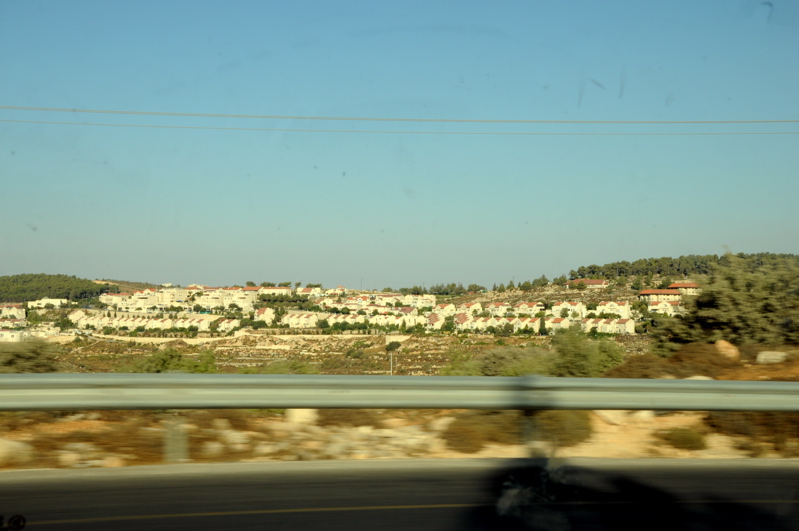
Photo: on the way to Hani´s house, Tel Rumeida settlement in the upper left corner.
One day we took of our vests and joined a tour of
"Breaking the Silence". I had been on a tour to the South Hebron hills in 2008 and knew it was a must do to go down Shuhada Street with them.
Breaking the Silence is an organization of veteran Israeli soldiers that collects testimonies of soldiers who served in the Occupied Territories during the Second Intifadah. Cases of abuse towards Palestinians, looting, and destruction of property have been the norm for years, but are still excused as military necessities, or explained as extreme and unique cases. The testimonies collected by
BTS demonstrate the depth of corruption which is spreading in the Israeli military. Discharged soldiers who return to civilian life discover the gap between the reality which they encountered in the Territories , and the silence which they encounter at home. In order to become a civilian again, soldiers are forced to ignore their past experiences. This is specifically problematic as for many of them the army service is a life changing experience in a traumatic sense.
Until today,
Breaking the Silence interviewed hundreds of soldiers who served in the territories, and continues interviewing soldiers daily. These interviews are published on their website, in testimonial booklets, through different media outlets, and also through lectures and tours to Hebron. The testimonies are published with minimal editing and with complete confidentiality, in order to protect the soldiers and to encourage them to speak.
They demand accountability regarding Israel's military actions in the Occupied territories perpetrated by us and in our name.

Photo: Our "bodyguards" waiting to escort the group after visiting Hani´s house.

Committing assaults is not necessarily leaving the perpetrator´s mind untouched.
The soldiers are young, between 18 and 21 yrs of age and not well prepared for the service. They don´t know much about Palestinians, except for "the fact" that they are the enemy. Yehuda and Michael (BTS) told us about military practise like breaking through walls at night from one house to the other,

randomly shooting at furniture and TV sets, sometimes discovering there was a little child sleeping just next to the hole they broke into the wall of a Palestinian home.
They also talked about a common practise in the IDF to take the coat of rubber bullets in order to make them even more dangerous. I remembered that when meeting with
New Profile, an Israeli Organisation supporting conscientious objectors of army service, one mother told us how her son learned about the Geneva Conventions when joining the army and how to shoot with dum dum ammunition (actually prohibited under Israeli military law) right afterwards.
Michael and Yehuda had taken us to Hani Abu Haykal´s house,

where Michael Zupraner, Israeli artist and human rights activist came to talk about an experimental community channel that will broadcast over the Internet out of Hebron, Palestine (link on this blog).

Michael is actually living in Issa Amro´s (B´Tselem field worker and EAPPI local contact) photo above) house in Tel Rumeida. As an Israeli citizen he was able to register as a resident in H2, this is why we kept referring to him (affectionately) as the "fair trade settler". This is where Issa and Michael created the cutting-edge broadcast initiative,
www.heb2.tv, which focuses on daily life of Palestinians in the Israeli-controlled ‘H2' sector of Hebron, Palestine. Equipped with video cameras through B'Tselem's "Camera distribution Project", Palestinians record their own point-of-view for the first time, turning their lenses on neighbouring settlers, soldiers and themselves. This footage, combined with scenes from H2 Hebron, interviews with former soldiers who served there, and conversations with the families behind the cameras reveals the reality of the conflict from a perspective rarely seen otherwise.

Breaking the Silence tours take you through Tel Rumeida, down Shuhada Street past the settlements of Beit Hadassah, Beit Romano and Avraham Avinu.

The settlers feel provoked by these tours as they know that the groups are introduced to the scenery in a very critical way. So they film the tours, aiming to collect evidence for what they feel shouldn´t be happening. In the picture above you can see David Wilder, settler spokesperson in Hebron.

The name of the man in the picture above is Afwar, he works in the Gotnic Centre (Jewish Community Centre in Hebron, right below the Mosque). I ran into him on another day, when inquiring about Palestinians being detained at a checkpoint leading to Shuhada. He got quite enraged about the soldiers talking to me and when I asked him to speak English and talk to me rather than about me, he left - after a quick verbal abuse.

The Breaking the Silence tours have been prevented and restricted by the Israeli Government many times. One of the main arguments in court was that the tours are too expensive for the Government because of the necessary protection by the Israeli Police.
Indeed I felt save amongst approximately 30 tourists and at least 60 police officers when walking past the settlements and during the short, but intensively agressive encounters with the settlers shown in the pictures.

So this is the same line of argumentation which is used to justify the extremely high number of soldiers in Hebron 2 (between 1700 and 2200), whose sole purpose is to protect the settlers.

Shudada Street is completely closed for Palestinian traffic, in many areas also for Palestinian pedestrians.

This part for example. The paintings on the wall display the same intolerance for other religions on this territory as the settlers' behaviour.

Michael sharing his experiences and discussing international law with the group.

The settlers have visiting groups of their own. I couldn´t help but wondering about the power of conviction. Otherwise they would be able the inhumanity and injustice in this place.

It´s virtually jumping at you when passing the encaged balconies of

Palestinian residents on Shuhada Street. They are a necessary protection from stones being thrown at them. The Iron doors of the formerly busy shopping street are welded shut and few Palestinians still living on Shuhada have to enter their homes through the back door.

This settler youth on the other hand displayed no sign of fear and neither did his peers.

This road block is separating Shuhada from the souk - the claim is security reasons.

The building in the background is the former vegetable market - the most important one in the region - it´s closed and has a military base adjoining.

Israeli cars are allowed on the entire street - all the way down through the Wadi al Hussein to the settlement of Kiriat Arba, home to approximately 7000 settlers. They are said to be followers of the late Rabbi Kahane, whose political party Kach has been banned from the Knesset as a terrorist organisation.

It´s like entering a different world. Perfectly paved streets, pedestrian crossing which could be anywhere in Europe. And then of course, the reason why we are here:
the grave of Baruch Goldstein, who killed 29 men and boys during the Ramadan in 1994.

It has become a pilgrimage site for radical settlers.

This photo needs a little attention to detail: while Palestinians are not allowed to carry any weapons, let alone to own regular sized kitchen knifes, the settlers carry arms. The revolver on this settlers belt being the moderate version.




 The way to the souq shortly before Iftar is quite a challenge - the Darwinist approach prevails - first come first serve:-) What if nobody was there, first?


